
How to Build Emotional Intelligence in Remote Teams
Updated: 3 days ago
Remote work can make people more efficient and more isolated at the same time. A teammate may answer every message on time and still feel unseen. A manager may think silence means agreement when it really means confusion, stress, or fear of speaking up.
Emotional intelligence helps fill that gap. It gives remote teams a shared way to read the room when there is no room. It helps people notice tone, manage tension, ask better questions, and repair damage before small misunderstandings become lasting resentment.
The work of learning how to build emotional intelligence in remote teams is practical. It is not about turning work into group therapy. It is about creating habits that make trust easier to build and harder to break.

Remote work changes how emotions show up
In a shared workplace, people pick up on small cues all day. A tired expression, a tense hallway pause, a quick laugh, or a change in someone’s usual rhythm can give context before anyone says a word.
Remote teams lose many of those signals. Messages arrive without facial expression. Video calls compress body language into small boxes. Async work adds delays, and delays invite stories.
A short reply can mean:
The person is busy.
The person is upset.
The person is focused.
The person is in a different time zone and responding between responsibilities.
The person thinks the answer is obvious.
Without emotional intelligence, teams guess. With it, teams check.
Remote emotional intelligence rests on four simple skills:
Self-awareness
People can name their own reactions before acting on them.
Self-management
People pause, choose their tone, and avoid spreading stress.
Empathy
People ask what might be true for someone else before judging.
Relationship repair
People address friction directly and respectfully.
These skills matter more in remote work because the environment gives fewer clues and more room for misread intent.
A healthy remote team does not avoid emotion. It treats emotion as useful information, then decides what to do with it.
Set communication norms before tension rises
Many remote conflicts are not really about personality. They are about unclear rules.
One person sees a late reply as rude. Another sees it as normal async work. One person expects decisions to happen in meetings. Another expects written feedback first. One person reads a period at the end of a sentence as cold. Another writes that way all the time.
Teams can reduce this noise by building clear communication norms. These norms should be simple enough to remember and specific enough to use.
A useful set of norms may cover:
Expected response times for chat, email, and project comments
When to use async updates instead of live calls
How to flag urgent work without creating false alarm
How decisions get made and recorded
When cameras are optional
How to disagree in writing
What to do when a message feels unclear or tense
The best norms remove guesswork. They also protect people from having to be constantly available.
For example, instead of saying “respond quickly,” a team might agree:
Chat is for same-day topics.
Project comments are for work that can wait one to two business days.
A phone call or urgent tag is only for blocked work that affects others right now.
That kind of clarity lowers emotional load. People stop wondering whether they are failing an invisible test.
Teams should also make tone explicit. Written communication needs more care than spoken conversation because it carries less context. A few habits help:
Start with intent when giving feedback.
Use plain language rather than hints.
Ask one question at a time.
Avoid sarcasm in work channels.
Read tense messages twice before replying.
Move heated topics to a live conversation when needed.
A remote team with strong emotional intelligence does not rely on everyone having the same style. It builds enough shared structure so different styles can work together.
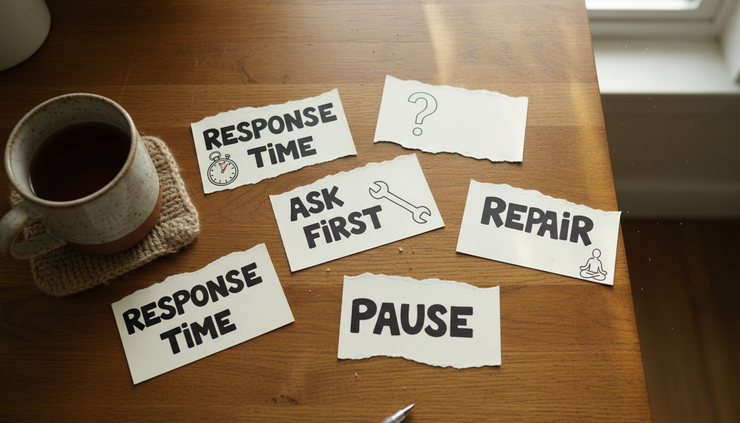
Make emotional check-ins normal and lightweight
Emotional check-ins work best when they are brief, honest, and low pressure. If they feel forced, people perform instead of sharing. If they take too long, they become another meeting burden.
The goal is not to make everyone disclose private details. The goal is to give the team enough emotional context to work well together.
Try lightweight prompts such as:
What is your energy level today?
What is one thing that might affect your focus this week?
Are you clear, blocked, or uncertain?
What do you need more of right now?
What should the team know before we plan this work?
Some teams use a simple color system.
Green means steady and ready.
Yellow means stretched, distracted, or partly blocked.
Red means overloaded or unable to take on more.
This works because it gives people language without requiring a long explanation. A person can say, “I’m yellow today. I can handle my current tasks, but I need fewer new requests.” That one sentence prevents confusion later.
Remote leaders should model this first. If managers always say, “I’m great,” even during obvious stress, others learn that check-ins are theater. A better example sounds like this:
“I’m focused, but I have low energy today. I may respond more slowly after 3 p.m. If something is time-sensitive, please tag me clearly.”
That kind of honesty sets boundaries without oversharing.
For async teams, check-ins can happen in written updates. A weekly status note might include:
Work completed
Current priorities
Blockers
Confidence level
Help needed
The confidence level matters. A project can look fine on paper while the person doing the work feels unsure, isolated, or stuck. When people can share uncertainty early, the team can respond before the deadline turns into a crisis.
Keep check-ins optional in depth. Make the prompt routine, but let people choose how much to say. Trust grows when people have control over their own disclosure.
Teach managers to notice patterns, not just problems
Managers shape the emotional climate of remote teams. They decide which behaviors get attention, which issues get ignored, and whether people feel safe raising hard topics.
A remote manager cannot rely only on output. Work may look fine until someone burns out, disengages, or leaves. Emotional intelligence asks managers to watch for patterns.
Common signals include:
A usually active person goes quiet.
A steady performer starts missing small details.
A teammate stops asking questions.
Written replies become shorter or sharper.
Someone avoids live conversations after conflict.
A person keeps saying yes but delivers late.
None of these signs prove anything on their own. They are reasons to check in, not reasons to accuse.
A good check-in sounds specific and open:
“I noticed you have been quieter in planning threads this week. I may be reading that wrong. How are things going?”
That phrasing gives the person room to correct the assumption. It also shows care without making a diagnosis.
One-on-ones should include more than task updates. Useful questions include:
What part of your work feels clear right now?
What feels heavier than it should?
Where do you need a faster answer from me?
Is there any conversation we are avoiding?
What is one thing that would make next week easier?
Managers also need to respond well when people answer honestly. If someone shares stress and receives defensiveness, punishment, or a quick motivational speech, they may not share again.
A better response follows three steps:
Acknowledge what you heard.
“That sounds frustrating, especially after the timeline changed.”
Ask what support would help.
“Do you need a decision, more context, or someone to take part of this?”
Agree on the next step.
“Let’s move the deadline discussion into the project thread today and make the tradeoffs clear.”
This keeps empathy connected to action. People do not need managers to fix every feeling. They need managers to take their experience seriously.

Build repair into the team culture
Every team misreads messages. Every team has tense moments. Emotional intelligence does not prevent all conflict. It helps people recover faster and with less damage.
Remote teams need repair habits because distance can make conflict linger. After an awkward call or sharp comment, people return to separate spaces. There may be no casual moment later to soften the exchange.
Repair should be normal, direct, and timely.
A simple repair message might say:
“I think my message came across more sharply than I intended. I was trying to move the decision forward, but I can see how the tone landed poorly. I’m sorry. Let me restate it more clearly.”
Another might sound like:
“I left yesterday’s call unsure where we stand. I sensed tension around the timeline. Can we talk for 15 minutes and clear it up?”
These messages work because they avoid blame. They name the moment, describe the impact, and invite a better conversation.
Teams can make repair easier by agreeing on a few shared rules:
Address tension early when possible.
Assume misunderstanding before bad intent.
Critique the work without labeling the person.
Restate what you heard before responding.
Apologize for impact, not only intent.
Put decisions in writing after emotional discussions.
The line between healthy conflict and harmful behavior still matters. Emotional intelligence should never become an excuse to tolerate disrespect. Clear standards protect trust. People should be able to disagree, question plans, and express frustration without insults, threats, or repeated dismissive behavior.
Remote teams also need to watch for exclusion. Time zones, language differences, caregiving schedules, and cultural norms can shape how people participate. A person who speaks less in live calls may contribute deeply in writing. A person who avoids quick debate may need time to think. A person who sounds direct may not mean to be harsh.
Emotionally intelligent teams create more than one way to be heard.
That may mean:
Sending agendas before calls
Inviting written feedback after discussions
Rotating meeting times when teams span time zones
Recording key decisions for people who could not attend
Asking quieter teammates for input without putting them on the spot
Leaving space between proposal and decision when stakes are high
Inclusion is not a side benefit. It is part of emotional accuracy. The team makes better judgments when it hears more of what people know and feel.
Keep emotional intelligence alive over time
Emotional intelligence fades when teams treat it as a workshop topic instead of a working habit. The pressure of deadlines can push people back into rushed messages, hidden stress, and avoidable conflict.
Maintenance matters.
A remote team can keep emotional intelligence strong with a few regular practices.
Review team norms every few months
Communication agreements should change as the team changes. A norm that worked for five people may fail at 20. A response-time rule may need adjustment across time zones. A meeting routine may become too heavy.
Ask:
What norm still helps us?
What norm do we ignore?
Where are we creating unnecessary stress?
What keeps causing confusion?
What should we stop doing?
Keep the answers short and turn them into visible updates.
Add emotional context to retrospectives
Project reviews often focus on scope, timing, and process. Add a human layer.
Ask:
Where did collaboration feel easy?
Where did tension show up?
What did we avoid saying until late?
Who was carrying hidden work?
What should we repeat next time?
These questions teach the team to treat emotion as part of performance, not a distraction from it.
Onboard for behavior, not only tools
New hires often learn which apps to use before they learn how the team handles disagreement, urgency, feedback, and mistakes. That leaves them guessing.
A strong remote onboarding process explains:
How the team communicates under pressure
How to ask for help
How feedback is given
How decisions are documented
How conflict gets handled
What healthy boundaries look like
Pair new teammates with someone who can explain the unwritten norms. Better yet, write the norms down so people do not need insider access to succeed.
Protect recovery time
Emotionally intelligent teams respect human limits. Remote work can blur the edge of the day, especially when teammates work across time zones. If every hour can become a work hour, people lose the space they need to regulate stress.
Healthy teams make recovery visible by:
Avoiding nonurgent after-hours messages
Using scheduled send when possible
Respecting focus blocks
Naming true urgency clearly
Planning around time off instead of treating it as a problem
Encouraging people to disconnect without apology
Boundaries are not a perk. They help people show up with patience, judgment, and care.

The real test is what happens under pressure
It is easy for a remote team to sound emotionally intelligent when work is calm. The real test comes when a launch slips, a customer is upset, a teammate makes a mistake, or leadership changes direction.
Under pressure, emotionally intelligent teams do a few things differently.
They slow down enough to understand the problem. They separate facts from assumptions. They ask who is affected. They name tradeoffs. They repair quickly when tone gets rough. They do not confuse silence with agreement or speed with alignment.
Most of all, they make it safe to tell the truth early.
That safety is built through small repeated moments:
A manager thanks someone for raising a risk.
A teammate asks for clarification instead of reacting.
A group pauses before piling work onto the same reliable person.
Someone apologizes without being forced.
A decision maker explains the reason behind a hard call.
A team changes a norm that no longer serves the work.
Those moments add up. Over time, they create a team where people can be honest without being careless, kind without avoiding hard topics, and productive without pretending stress does not exist.
Emotional intelligence in remote teams is not a personality trait some people have and others lack. It is a set of skills, practices, and agreements that improve with use.
Start small. Pick one norm to clarify, one check-in question to use, or one repair habit to model this week. Remote trust grows through repetition. The team does not need perfect communication. It needs enough awareness, care, and courage to keep coming back to the conversation.



Comments